top of page

MoveBetter
AI-Enhanced Physical Therapy Assistant App

This project was driven by a goal to enhance the physical therapy experience for patients outside the clinic. MoveBetter is an innovative mobile application that leverages AI to deliver personalized physical therapy programs. The app monitors patient progress, provides real-time feedback on exercises, and facilitates effective communication between patients and physical therapists.
Project Type
My Role
Personal Project
end-to-end UX Designer
Duration
Tools
4 weeks
Figma
Miro
PROJECT OVERVIEW
Developing the MoveBetter app marked a significant milestone in my UX design journey. This was my first project after dedicating months to improving my skills, and it served as a prime opportunity to showcase what I had learned. Over several weeks, I designed a mobile application aimed at transforming how patients engage with their physical therapy routines at home. Through in-depth user research, detailed wireframes, and iterative design refinements based on feedback from both patients and therapists, I created an AI-powered platform that offers personalized exercise programs, tracks progress, and facilitates effective communication.
User Goal:
To effectively manage and enhance physical therapy treatment at home by receiving personalized exercise plans, real-time feedback, and ongoing support through MoveBetter.
KPIs & Success Metrics:
-
User Engagement Rate
-
Progress Improvement
-
Patient-Therapist Communication Efficiency
-
User Satisfaction and Retention
Organization Goal:
To develop an innovative mobile app that leverages AI to deliver customized physical therapy programs, streamline patient progress monitoring, and facilitate effective communication between patients and therapists.
The Research
My research goals were to understand:
Main takeaways from User Interviews:
-
What are the most common challenges patients face when following physical therapy routines at home?
-
What motivates patients to adhere to their therapy plans, and what factors contribute to disengagement?
-
How can AI be effectively integrated into a physical therapy app to personalize treatment and improve outcomes?
Patients often feel disconnected from their physical therapists when not in the clinic, leading to uncertainty about their progress and whether they are performing exercises correctly.
Therapists expressed a need for more efficient ways to monitor patient progress remotely, as they currently rely on patient self-reporting, which can be inconsistent and inaccurate.
Motivation is a significant barrier for many patients, with several noting that they struggle to stay committed to their therapy routines without regular feedback and encouragement.
Some apps offer video demonstrations and tracking features, which users find helpful for maintaining proper form and staying on track.
Apps with built-in communication tools between patients and therapists are valued for facilitating timely feedback and adjustments.
Strengths
Competitive Analysis
Many existing apps lack personalized therapy plans tailored to individual progress, relying instead on generic programs that do not adapt to user needs.
Few apps incorporate AI, limiting their ability to provide real-time adjustments and insights based on user data.
User interfaces in many apps are not intuitive or accessible, particularly for older users or those with limited technical skills.
Weaknesses
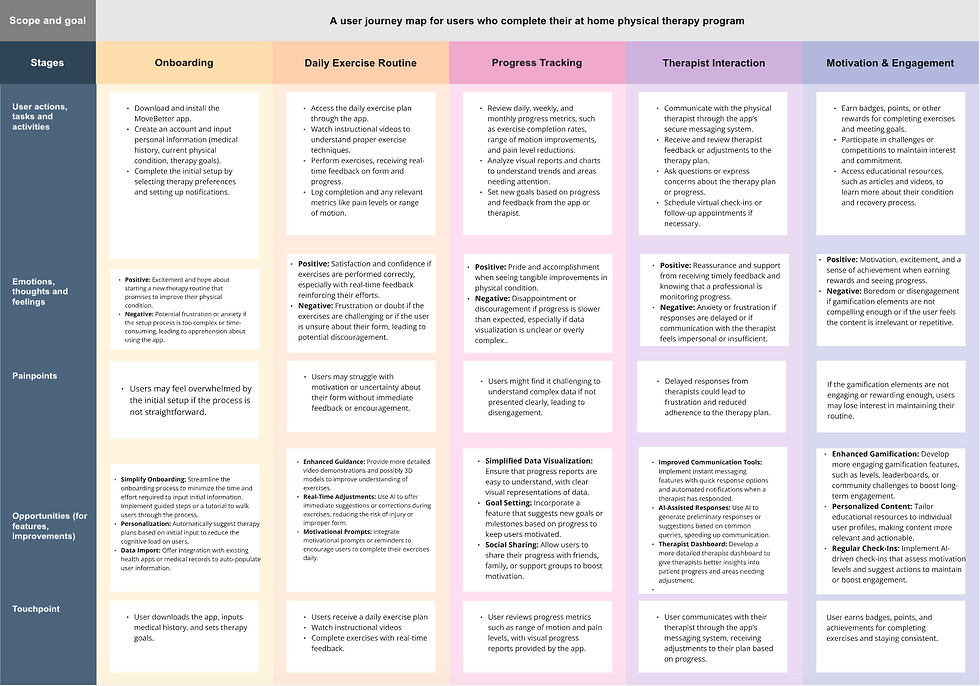
User Journey Mapping
The Design Process
Lo-Fidelity Wireframes
Onboarding Flow

Patient Therapy Flow

Hi-Fidelity Wireframes
Onboarding Flow

Patient Therapy Flow

bottom of page